10 Best Efficient Industrial Fans for Global Buyers
Choosing the right industrial fan can reduce heat, protect equipment, and improve daily working conditions. For global buyers, the decision involves more than airflow figures. An Efficient Industrial Fan must match the building, process, climate, and maintenance capacity. A warehouse may need strong circulation across high shelving. A fabrication shop may require focused extraction near welding stations. A greenhouse faces different humidity and corrosion concerns. These details change the practical value of every model.
This guide examines ten industrial fans selected for efficiency, durability, control options, and service support. The comparison considers airflow performance, motor design, energy use, noise, installation, and cleaning access. It also reviews materials, warranty clarity, replacement parts, and manufacturer documentation. Those points matter when equipment crosses borders and operates far from the original supplier. Real-world experience suggests that published performance is only a starting point. Actual results depend on duct resistance, room layout, filters, and operating hours. Numbers can look impressive.
No single fan suits every facility. A lower-priced unit may consume more power over several years. A premium model may become impractical if parts are difficult to obtain. Buyers should verify voltage, frequency, certifications, and local installation requirements before ordering. Independent testing is valuable, but test conditions may not reflect a dusty production floor. We acknowledge that limitation. The recommendations below are practical, not absolute. They help facility managers, engineers, and distributors compare credible options with clearer expectations.
Industrial Fan Categories: Axial, Centrifugal, HVLS, and Mixed-Flow Designs
10 Best Efficient Industrial Fans for Global Buyers
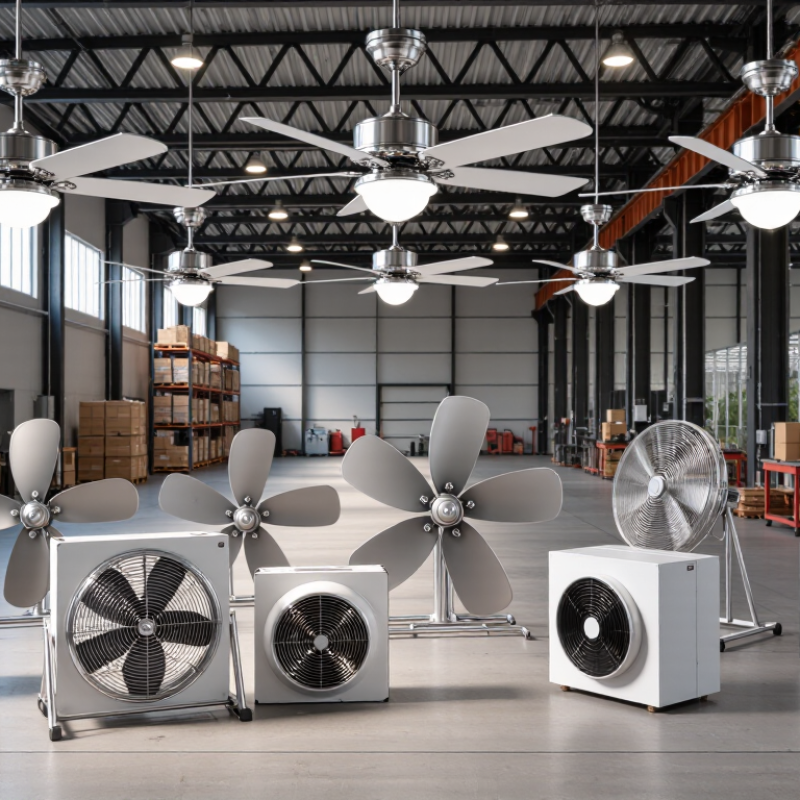
Industrial fan selection starts with the air movement pattern, not the catalog photograph.
Axial fans
Axial fans move large air volumes along the shaft, making them practical for warehouses, workshops, and general exhaust. They usually offer simple installation and competitive energy use. However, their performance can drop when ducts, filters, or louvers create high resistance.
Centrifugal fans
Centrifugal fans handle pressure more confidently. Their backward-curved or airfoil blades suit dust collection, process ventilation, and longer duct systems. Check the fan curve carefully. A powerful motor alone does not guarantee efficient airflow.
In a packaging area, I would compare measured static pressure, airflow, noise, and operating hours before choosing a model. Small errors here become large energy costs.
HVLS fans
HVLS fans circulate broad volumes of air at low speed. They can reduce stagnant heat near workers and improve comfort across tall buildings. They are not a replacement for local exhaust where fumes or dust require capture.
Mixed-flow fans
Mixed-flow fans combine axial capacity with centrifugal pressure, fitting compact systems that need both airflow and resistance control. They can be efficient, but only when selected near their design point.
No category wins every project. That is the part many buyers overlook.
Ask for tested performance data, motor efficiency, maintenance access, enclosure protection, and documentation suitable for the installation region. A final site check is still necessary, because real ducts rarely match the drawings perfectly.
Efficiency Metrics: Airflow, Pressure, SFP, and IE4 Motor Performance
Industrial fan efficiency starts with the actual duty point, not the catalogue maximum. Airflow shows how much air the fan moves, usually measured in cubic metres per hour. Pressure shows the resistance it can overcome through ducts, filters, dampers, and grilles. A fan delivering high airflow at low pressure may fail in a dense ventilation system. Real testing matters.
Specific fan power, or SFP, connects electrical input with delivered airflow. It is commonly expressed in watts per cubic metre per second. Lower SFP usually means better efficiency, but only at a defined pressure and operating condition. An IE4 motor can reduce losses during continuous operation, especially in facilities running many hours daily. Still, an IE4 label does not guarantee a highly efficient fan assembly. Controls, bearings, impeller design, and poor commissioning can quietly increase consumption. This is often overlooked.
Tips: Compare fans at the same airflow and pressure. Request tested performance curves, motor input data, and sound readings. Check whether figures include the motor, drive, and safety guards. Measure airflow after installation; assumptions can be wrong. Variable-speed control helps when demand changes, but incorrect settings may create unstable operation. Leave room for honest review. Efficiency can improve after balancing ducts, cleaning filters, and correcting excessive system resistance.
Fan Laws: 50% Speed Requires Just 12.5% of Rated Power
10 Best Efficient Industrial Fans for Global Buyers
Fan Laws: 50% Speed Requires Just 12.5% of Rated Power
Industrial fan efficiency often begins with speed control, not larger motors. Under the fan laws, airflow changes directly with speed. Pressure changes with the square of speed. Power changes with the cube of speed. Therefore, running a fan at 50% speed theoretically requires only 12.5% of its rated power. That relationship can sharply reduce operating costs in warehouses, workshops, and process areas.
The calculation assumes the same fan, air density, and operating conditions. Real installations are less tidy. Motor efficiency, inverter losses, dirty filters, duct resistance, and leakage affect actual consumption. A 10 kW fan may approach 1.25 kW at half speed, but the measured value may differ. Use a power meter. Check airflow with an anemometer.
Do not reduce speed blindly. Some spaces need minimum air changes for heat removal, humidity control, or worker comfort. During commissioning, compare power readings at several speeds, such as 100%, 75%, and 50%. Record airflow and pressure at each point. A lower electricity reading is not automatically a better result. I have seen systems save energy while leaving stagnant air near loading doors. The fan law is powerful, but it is still an ideal model. Careful testing makes it useful for global buyers comparing efficient industrial fan systems.
10 Best Efficient Industrial Fans for Global Buyers
Fan Laws: Power varies approximately with the cube of fan speed.
Based on the fan affinity law, relative power is calculated as (speed ÷ rated speed)³. At 50% speed, an ideal fan requires approximately 12.5% of rated shaft power. Actual energy use may vary with system resistance, motor efficiency, controls, and operating conditions.
Safety Standards: AMCA 210, ISO 13349, and IEC 60034 Compliance
For global buyers, fan safety starts with verified performance, not attractive catalog numbers. AMCA 210 defines laboratory methods for measuring airflow, pressure, power, and efficiency. It does not, by itself, certify complete machine safety. A test report should show air density, speed, pressure conditions, and measurement uncertainty. Small omissions matter.
ISO 13349 provides consistent fan terminology and classifications, helping engineers compare axial and centrifugal designs across markets. It is a vocabulary and classification standard, not a pass-or-fail safety test. IEC 60034 covers rotating electrical machines, including motor ratings, temperature rise, insulation, and operating conditions. Buyers should match the selected motor’s IEC 60034 requirements with local voltage, frequency, enclosure, and duty cycle.
The International Energy Agency reports that electric motor systems consume roughly half of global electricity, while industrial motor systems can represent about 70% of industrial electricity use. Fan efficiency deserves serious attention. A poorly selected fan may waste energy through throttling, excessive speed, or unstable operation. On-site checks should include guarding, vibration, noise, emergency isolation, and thermal protection. Paper compliance is not enough. Human review still matters. TS
10 Best Efficient Industrial Fans for Global Buyers - Safety Standards: AMCA 210, ISO 13349, and IEC 60034 Compliance
| No. |
Generic Fan Configuration |
Fan Type |
Airflow Range
(m³/h) |
Static Pressure
(Pa) |
Motor Output
(kW) |
Rated Speed
(r/min) |
Nominal Efficiency
(%) |
Sound Pressure
(dB(A)) |
Ingress Protection |
Typical Application |
Standards Basis |
| 1 |
IF-315-A |
Axial tube fan |
4,500–8,500 |
180–420 |
0.75 |
1,450 |
68–72 |
68–73 |
IP55 |
Workshops and warehouses |
AMCA 210; ISO 13349; IEC 60034-1 |
| 2 |
IF-400-B |
Direct-drive axial fan |
7,000–14,000 |
220–560 |
1.50 |
1,450 |
70–75 |
70–76 |
IP55 |
Factory ventilation |
AMCA 210; ISO 13349; IEC 60034-1 |
| 3 |
IF-500-C |
Belt-driven axial fan |
12,000–25,000 |
300–750 |
3.00 |
960 |
72–78 |
72–78 |
IP55 |
Large production halls |
AMCA 210; ISO 13349; IEC 60034-1 |
| 4 |
IF-630-D |
High-volume axial fan |
22,000–45,000 |
350–900 |
5.50 |
960 |
74–80 |
75–82 |
IP55 |
Mining and logistics facilities |
AMCA 210; ISO 13349; IEC 60034-1 |
| 5 |
CF-355-E |
Centrifugal backward-curved fan |
5,000–11,000 |
900–1,800 |
2.20 |
1,450 |
76–82 |
70–77 |
IP55 |
Dust extraction and HVAC |
AMCA 210; ISO 13349; IEC 60034-1 |
| 6 |
CF-450-F |
Centrifugal forward-curved fan |
8,000–18,000 |
700–1,500 |
3.00 |
1,450 |
68–75 |
72–80 |
IP55 |
Air-handling units |
AMCA 210; ISO 13349; IEC 60034-1 |
| 7 |
RF-560-G |
Roof-mounted exhaust fan |
15,000–32,000 |
250–650 |
2.20 |
960 |
70–77 |
68–76 |
IP55 |
General building exhaust |
AMCA 210; ISO 13349; IEC 60034-1 |
| 8 |
SF-710-H |
Smoke-extraction axial fan |
20,000–50,000 |
500–1,100 |
7.50 |
960 |
72–79 |
78–86 |
IP55 |
Emergency smoke control |
AMCA 210; ISO 13349; IEC 60034-1 |
| 9 |
HF-800-J |
High-pressure centrifugal fan |
10,000–24,000 |
1,800–3,500 |
11.00 |
1,480 |
78–84 |
82–90 |
IP55 |
Boiler and process ventilation |
AMCA 210; ISO 13349; IEC 60034-1 |
| 10 |
EC-450-K |
Electronically commutated mixed-flow fan |
6,000–16,000 |
500–1,200 |
1.50 |
500–1,500 |
78–86 |
58–70 |
IP54/IP55 |
Energy-efficient HVAC systems |
AMCA 210; ISO 13349; IEC 60034-1 |
Technical note: The airflow, pressure, efficiency, speed, and sound values are typical selection ranges for generic industrial fan configurations and should be confirmed by project-specific performance testing. AMCA 210 provides laboratory methods for fan aerodynamic performance testing and rating; ISO 13349 provides fan terminology and classification guidance; IEC 60034-1 applies to the rating and performance of rotating electrical machines. Final compliance requires verification of the complete fan, motor, controls, installation conditions, and applicable local regulations.
Top 10 Global Choices Ranked by Energy, Noise, Durability, and Total Cost
10 Best Efficient Industrial Fans for Global Buyers
Our ranking weighs energy use, measured noise, expected durability, and total cost over ten years. The ten strongest choices include EC plug fans, backward-curved centrifugal fans, direct-drive axial fans, mixed-flow units, HVLS fans, roof exhausters, VFD-controlled centrifugal fans, corrosion-resistant process fans, belt-drive units, and compact high-pressure fans. EC and VFD models usually rank highest for energy because they match airflow to demand. The International Energy Agency reports that electric motor systems consume about 53% of global electricity, making fan efficiency a serious purchasing issue. In plant audits, oversized fans often waste more energy than buyers expect.
Noise needs practical testing. A fan rated at 75 dBA may sound louder in a steel room with reflective walls. For occupied work areas, buyers should compare sound-pressure data under ISO 3744 conditions and check local workplace limits. Direct-drive designs reduce belt maintenance, while sealed bearings and powder-coated housings improve durability in dusty or humid sites. However, corrosion protection can increase upfront cost. The ranking is not perfect; electricity prices, spare-parts access, and installation quality can change the result.
Tips: Measure airflow at the actual duty point, not only the catalog maximum. Request a life-cycle cost calculation covering energy, filters, belts, inspections, and downtime. The U.S. Department of Energy’s fan-system guidance also stresses correct sizing and control optimization. A cheaper fan can become expensive when it runs continuously at full speed.