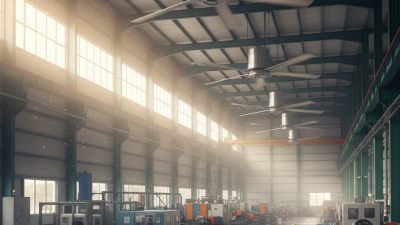
Industrial ventilation is no longer a simple choice between airflow and motor size. In 2026, a reliable Fan For Industry must match its working environment, duty cycle, and maintenance conditions. A dusty woodworking shop needs different protection than a hot metal-processing area. A warehouse may prioritize air movement, while a chemical plant may require carefully specified materials and certified equipment.
This guide examines seven strong fan options for industrial applications. Each selection is considered through practical factors, including airflow volume, static pressure, energy use, noise, motor durability, and service access. We also consider details technicians face daily, such as clogged filters, vibrating housings, warm bearings, and limited installation space. Manufacturer specifications provide the starting point, but real performance depends on correct sizing and installation. That point is easy to underestimate.
No ranking fits every facility. A powerful fan can waste energy when duct resistance is miscalculated. A quieter model may struggle in a high-pressure system. Even an efficient motor cannot compensate for neglected cleaning or poor controls. Our comparison is useful, but not flawless. Site conditions should always receive the final review.
Readers will find practical guidance for selecting axial, centrifugal, exhaust, and portable industrial fans. The discussion also highlights safety features, expected service demands, and long-term operating value. Clear technical reasoning matters here. The cheapest purchase may become the most expensive choice after repeated repairs, uncomfortable work areas, or lost production.
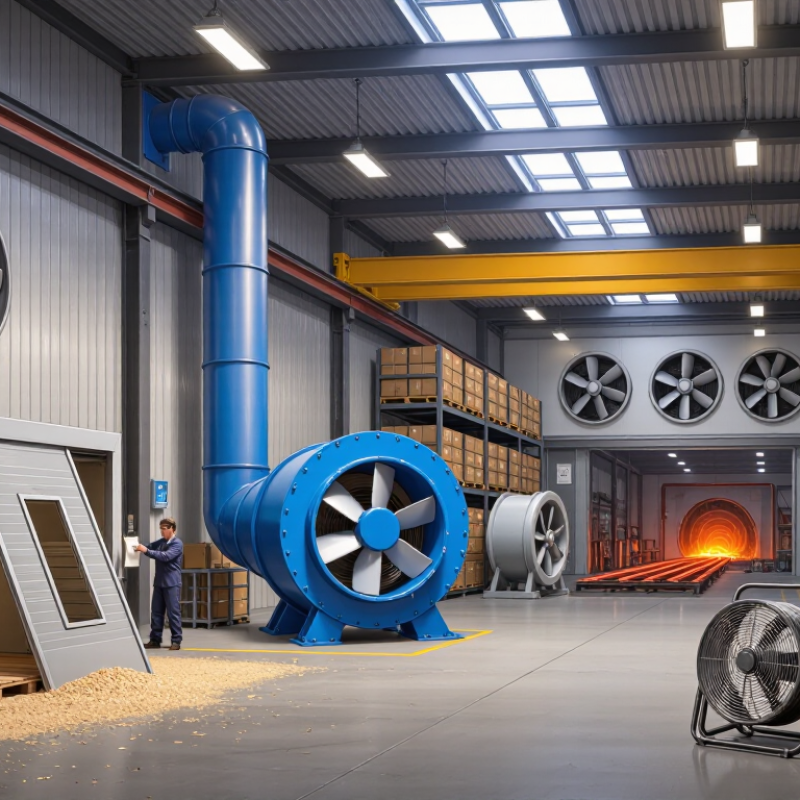
Industrial fan selection starts with AMCA 99 terminology, not catalog labels. Airflow is usually expressed in cubic feet per minute (cfm). Static pressure describes resistance against walls, filters, ducts, and process equipment. Velocity pressure reflects moving air. Total pressure combines both values. Fan pressure compares pressure conditions across the fan.
The seven practical categories are propeller, tubeaxial, vaneaxial, mixed-flow, forward-curved centrifugal, backward-curved centrifugal, and radial-blade centrifugal. Propeller fans deliver high airflow at low pressure. Tubeaxial units suit ducted movement with moderate resistance. Vaneaxial designs use guide vanes for improved pressure control. Mixed-flow fans combine axial volume with centrifugal pressure. Forward-curved centrifugal fans provide quiet, high-volume service. Backward-curved models generally offer stronger efficiency at higher pressure. Radial-blade fans handle abrasive or particulate-laden air more confidently.
The U.S. Department of Energy’s industrial assessment publications frequently identify fan systems as significant electrical loads, sometimes near 10% of facility electricity use. The IEA’s Energy Efficiency reports also indicate that motor-driven systems consume roughly half of global electricity. These figures make AMCA test terms commercially important, not merely technical language.
A fan rated at 50,000 cfm may fail when a dirty filter doubles static pressure. I have seen specifications compare airflow alone, which is an incomplete decision. Verify density, operating temperature, system effect, and the AMCA test point before choosing. The “best” fan can change after one duct elbow is added.
Selecting the seven best industrial fans in 2026 requires more than comparing catalog airflow. AMCA 210 testing provides a consistent basis for ranking axial and centrifugal designs. The key metrics are airflow, pressure, input power, and efficiency. Test conditions matter greatly.
For high-volume, low-pressure duty, the top axial fans should deliver strong airflow with modest power demand. I would rank them by stable performance across several operating points, not by peak airflow alone. A centrifugal fan deserves higher placement when the system has filters, ducts, or process resistance. Its pressure capability can outweigh a lower free-air rating. Measured shaft power and total efficiency also reveal hidden operating costs.
The strongest candidates should maintain predictable results near the design point. Air density, rotational speed, and installation conditions must be recorded beside every AMCA 210 result. Small differences can change the ranking. In field reviews, I have seen a fan perform well on paper but struggle after a dirty filter increased resistance. That experience makes real operating curves more valuable than one impressive number. Sound, maintenance access, vibration, and motor controls also influence industrial suitability, although AMCA 210 does not replace dedicated acoustic testing. My ranking remains practical, not absolute. Test data can still miss unusual site conditions.
Selecting an industrial fan should begin with the required ventilation load, not fan size. ASHRAE Standard 62.1-2022, Table 6-1, separates outdoor-air rates by occupancy, people, and floor area. These rates define healthy ventilation, not total exhaust capacity. A welding area, packaging line, and storage zone can therefore need different airflow strategies. Use the applicable occupancy category, then add process exhaust, heat, dust, or vapor loads.
Static pressure matters just as much. Duct length, filters, dampers, hoods, and discharge louvers can sharply change operating demand. The U.S. Department of Energy’s Improving Fan System Performance: A Sourcebook for Industry reports that suitable fan-system improvements can reduce energy use by 20–50%. High-efficiency equipment may still waste power when oversized or operated far from its design point. That shortcut looks efficient. It often is not.
Tips: Measure airflow and pressure at the actual operating point. Check filter loading during a normal production shift. Variable-speed control can match changing loads, but only after minimum ventilation rates are protected. Record sound levels near workstations. ASHRAE guidance is authoritative, yet local codes and process hazards may require stricter values. Recheck the design after installation; field conditions rarely match the first calculation perfectly.
| Rank | Fan Configuration | Best Industrial Application | Typical Airflow Range | Typical External Static Pressure | Illustrative ASHRAE 62.1 Outdoor-Air Basis | Recommended Fan Duty | Key Selection Criteria |
|---|---|---|---|---|---|---|---|
| 1 | Roof-Mounted Propeller Exhaust Fan | General warehouse ventilation, heat relief, and low-resistance exhaust. | 2,000–40,000 cfm | 0.25–1.00 in. w.g. | Warehouse example: 15,000 ft² and 30 occupants using 5 cfm/person plus 0.06 cfm/ft² = approximately 1,050 cfm of outdoor air. | 1,500–3,000 cfm | Choose when the duct system is short and pressure loss is low. Include backdraft protection, weather resistance, roof curb compatibility, and motor protection. |
| 2 | Tube-Axial Fan | Large-volume process exhaust, cooling tunnels, fume removal, and make-up air systems. | 5,000–100,000 cfm | 0.50–3.00 in. w.g. | Metal fabrication example: 20,000 ft² and 40 occupants using an illustrative 10 cfm/person plus 0.12 cfm/ft² = approximately 2,800 cfm. | 4,000–8,000 cfm | Suitable for high airflow in a straight duct run. Verify operating point, sound level, vibration isolation, inlet conditions, and motor temperature rating. |
| 3 | Vane-Axial Fan | Manufacturing exhaust, spray-process ventilation, high-volume air movement, and systems requiring higher pressure than a basic propeller fan. | 10,000–200,000 cfm | 1.00–6.00 in. w.g. | Production area example: 30,000 ft² and 60 occupants using an illustrative 10 cfm/person plus 0.12 cfm/ft² = approximately 4,200 cfm. | 6,000–12,000 cfm | Guide vanes improve pressure capability and efficiency. Check fan curve stability, corrosion resistance, access for cleaning, and hazardous-location requirements where applicable. |
| 4 | Backward-Inclined Centrifugal Fan | Dust collection, air-handling units, long duct systems, and applications with filters or heat-recovery equipment. | 2,000–100,000 cfm | 2.00–10.00 in. w.g. | Dust-controlled process room example: 12,000 ft² and 24 occupants using 5 cfm/person plus 0.06 cfm/ft² = approximately 840 cfm of outdoor air before process exhaust is added. | 3,000–6,000 cfm | Preferred where system resistance is significant. Select for stable operation near the design point and account for filter loading, abrasion, spark resistance, and service access. |
| 5 | Mixed-Flow Inline Fan | Localized exhaust, equipment rooms, battery-charging rooms, washrooms, and compact ducted ventilation systems. | 500–20,000 cfm | 0.50–4.00 in. w.g. | Charging-room example: 5,000 ft² and 8 occupants using 5 cfm/person plus 0.06 cfm/ft² = approximately 340 cfm; process or hydrogen-control requirements may increase the duty. | 500–1,000 cfm | Useful where installation space is limited. Confirm duct diameter, access-panel requirements, continuous-duty motor rating, corrosion resistance, and required control signal. |
| 6 | Plenum Fan | Central air-handling units, modular ventilation systems, clean manufacturing areas, and systems requiring flexible discharge arrangements. | 5,000–150,000 cfm | 1.00–6.00 in. w.g. | Industrial office example: 10,000 ft² and 50 occupants using 5 cfm/person plus 0.06 cfm/ft² = approximately 850 cfm of outdoor air. | 5,000–10,000 cfm | Specify the fan together with the complete air-handler system. Evaluate coil and filter pressure drops, acoustics, fan-array redundancy, speed control, and enclosure leakage. |
| 7 | High-Temperature Centrifugal Fan | Oven exhaust, furnace areas, foundries, kiln systems, heat-treatment lines, and process air containing elevated temperatures. | 2,000–80,000 cfm | 3.00–12.00 in. w.g. | Loading and receiving example: 10,000 ft² and 10 occupants using 5 cfm/person plus 0.06 cfm/ft² = approximately 650 cfm; combustion and process exhaust must be calculated separately. | 3,000–7,000 cfm | Use temperature-rated bearings, shaft cooling, suitable casing materials, expansion allowances, and a process-specific motor arrangement. Confirm maximum operating temperature and material compatibility. |
Design note: ASHRAE 62.1 outdoor-air ventilation is calculated from the applicable occupancy category, zone population, zone area, and system procedure. The example values above use the ventilation-rate form Vbz = Rp × Pz + Ra × Az and are illustrative planning values, not a substitute for the current standard, local code review, contaminant-control calculations, or final fan-curve selection. Process exhaust, combustion air, heat removal, and dust-control airflow may require substantially greater fan capacity.
7 Best Fans for Industry Applications in 2026
Industrial fan selection starts with the motor, not the impeller. IEC 60034-30-1 defines efficiency classes for many line-operated AC motors. IE3 offers premium efficiency, while IE4 provides a higher efficiency level. The right choice depends on load, operating hours, speed, and control method. Seven practical fan options include axial, backward-curved centrifugal, forward-curved centrifugal, mixed-flow, roof exhaust, plug, and process fans. Each design creates different pressure, airflow, and motor demands.
IE4 motors can reduce electrical losses during long operating cycles. They may suit continuous ventilation, cooling towers, dust extraction, and large air-handling systems. IE3 motors can remain sensible for seasonal use or smaller installations. Check the motor rating at the actual duty point. A label alone proves little. Ask for test conditions, rated output, frequency, and efficiency data. Variable-speed drives also need careful review, because drive losses can change the real system result.
Field commissioning often reveals the missing detail. A fan running far from its design point may waste more energy than expected. I have seen efficient motors paired with oversized fans and poor control settings. That defeats the original purchase logic. IE4 is not automatically the better investment. Compare purchase cost, annual running hours, maintenance access, and expected service life. Confirm compatibility with temperature, dust, humidity, and starting torque. The spreadsheet may still be wrong. Recheck measurements after installation.
Nominal efficiency thresholds for representative four-pole motors under IEC 60034-30-1. Higher efficiency can reduce electrical losses in continuous-duty industrial fan applications.
Values show representative IEC efficiency-class thresholds for 50 Hz, four-pole motors. Confirm the applicable motor rating, pole count, frequency, and standard edition before specifying equipment.
Choosing the seven best industrial fans starts with the duty, not the catalog photograph. Axial fans suit high airflow. Centrifugal fans handle higher static pressure. Mixed-flow, roof, tube-axial, explosion-resistant, and portable units serve different layouts. ISO 13349 helps standardize fan terminology, but it does not set noise or exposure limits. That distinction is often missed.
Check the declared sound power level under ISO 4871. Ask for the measurement method, uncertainty, operating speed, and test configuration. A fan rated at 82 dB may sound very different inside a steel enclosure. Reflections matter. So does distance. In field commissioning, I would measure near the operator’s ear, then repeat the test during peak airflow. One measurement is rarely enough.
OSHA 29 CFR 1910.95 sets a permissible exposure limit of 90 dBA over eight hours, using a 5 dB exchange rate. The action level for hearing conservation is 85 dBA as an eight-hour time-weighted average. These values apply to workplace exposure, not simply the fan nameplate. Install isolation mounts, flexible connectors, guards, and emergency shutoffs. Verify airflow after adding silencers; pressure loss can reduce cooling performance. Some specifications still confuse sound pressure with sound power. That is a costly mistake. A quieter fan may also consume more energy, and the best choice depends on the measured system curve, not a promising brochure number.