Leave Your Message
Choosing the right Bath Exhaust Fan can shape indoor comfort, energy use, and long-term maintenance. Global buyers face many options, from ceiling-mounted fans to wall, window, and inline duct models. Each design handles airflow, noise, humidity, and installation challenges differently.
A practical comparison should begin with the bathroom itself. A compact apartment may need a quiet ceiling fan with a short duct run. A large hotel bathroom may require stronger extraction, reliable controls, and continuous operation. Coastal projects also deserve closer attention to corrosion-resistant materials. Small details matter, such as backdraft shutters, washable grilles, duct diameter, and access for cleaning.
Performance claims need careful checking. Airflow ratings may use different testing conditions, so direct comparisons can become misleading. A fan rated highly on paper may perform poorly with long, narrow ducting. Noise figures can also change after installation. Real projects teach this lesson repeatedly.
No single model wins every bathroom. Buyers should review airflow, sound levels, motor design, controls, warranty support, and available replacement parts. Local electrical requirements and building practices must also be confirmed before purchase. Manufacturer data, independent testing, and installer feedback create a more dependable basis for decisions.
This guide examines the main Bath Exhaust Fan types for international sourcing. It considers practical applications, installation limits, operating costs, and common selection mistakes. Some conclusions may remain imperfect because climate, construction quality, and user expectations vary. That uncertainty deserves attention, not concealment. An informed choice balances published specifications with real bathroom conditions.
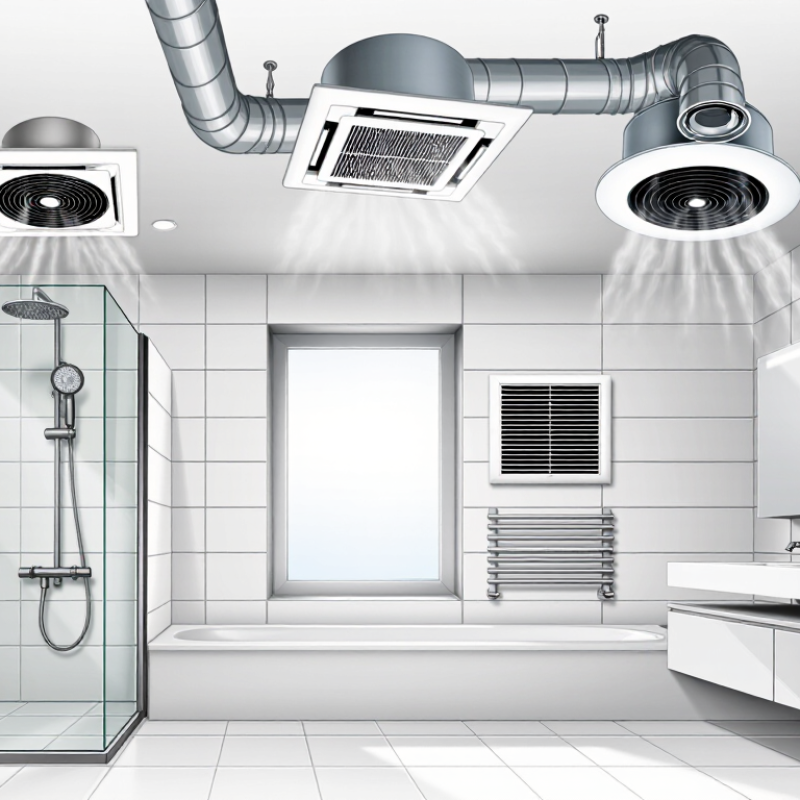
A bath exhaust fan removes humid, odorous air through a duct, usually discharging outdoors. It is not simply a ceiling appliance. Its motor, airflow, controls, noise level, and duct design determine whether it actually protects the room. ASHRAE Standard 62.2-2022 lists 50 cfm for intermittent bathroom exhaust or 20 cfm for continuous operation. EPA guidance also recommends keeping indoor relative humidity between 30% and 50%.
Type matters because bathrooms differ across buildings and climates. A ceiling-mounted ducted fan suits many compact homes, while a wall-mounted model can work better when the ceiling route is blocked. An inline fan places the motor away from the bathroom, often reducing perceived noise and serving longer ducts. Humidity-sensing models can start automatically after a hot shower, but their settings may need adjustment in coastal or rainy regions. A poor sensor setting can waste energy.
A global buyer should check voltage, frequency, duct diameter, backdraft protection, and local electrical requirements. HVI’s Certified Ratings Program shows why tested airflow and sound data matter; advertised performance may change after installation. A short, smooth duct is usually more effective than a long, sharply bent one. That detail is often overlooked. A larger fan is not always better, either. Excessive airflow can increase drafts and energy use, while an undersized fan leaves mirrors wet and corners damp. For reliable selection, compare certified performance with the room size, duct path, and expected moisture load. Real buildings rarely match showroom conditions.
| Fan Type | How It Works | Typical Airflow Range | Best-Suited Applications | Main Advantages | Key Limitations | Typical Control Options | Installation Considerations | Energy and Noise Profile |
|---|---|---|---|---|---|---|---|---|
| Ceiling-Mounted Exhaust Fan | Removes humid and stale air through a ceiling grille and discharges it through a duct to the exterior. | Approximately 50–150 CFM (85–255 m³/h) for residential bathrooms. | Most standard bathrooms where the ceiling provides convenient access to an exhaust duct. | Efficient room-wide air extraction; discreet appearance; suitable for centralized ceiling ventilation. | Requires adequate ceiling depth and correctly routed ductwork; poor duct design can reduce performance. | Wall switch, timer switch, humidity sensor, occupancy sensor, or smart control. | Use a short, smooth, and properly supported duct run whenever possible. Discharge outdoors rather than into an attic or ceiling cavity. | Usually moderate energy use. Noise commonly ranges from quiet to moderate, depending on motor and duct configuration. |
| Wall-Mounted Exhaust Fan | Extracts air directly through an exterior wall, often using a short duct path or an integrated wall sleeve. | Approximately 50–200 CFM (85–340 m³/h). | Bathrooms located against an outside wall, especially where ceiling access is limited. | Simple installation; shorter exhaust path; reduced concealed ductwork requirements. | Less suitable for interior bathrooms; exterior appearance and weather sealing must be considered. | Pull cord, wall switch, timer, humidity sensor, or automatic control. | Include an exterior weather-resistant grille, backdraft damper, and proper sealing around the wall penetration. | Can provide strong performance with a short duct run. Perceived noise depends heavily on wall construction and exterior grille design. |
| Inline Duct Fan | A separate fan unit is installed within the duct system, pulling or pushing air from one or more grilles. | Approximately 100–400 CFM (170–680 m³/h), depending on system design. | Large bathrooms, long duct runs, remote fan installations, or systems serving more than one room. | High available pressure; flexible placement; the motor can be positioned away from the bathroom to reduce perceived noise. | Higher installation complexity; requires access for maintenance and careful balancing of grilles and ducts. | Central switch, timer, humidity sensor, motion sensor, or building-management control. | Match the fan to the duct diameter and pressure requirements. Provide access panels where required for cleaning or servicing. | Efficient for long duct runs when correctly sized. Bathroom noise may be low, although duct airflow noise can increase at high speed. |
| Centrifugal Exhaust Fan | Uses a rotating impeller to move air radially, generating higher static pressure than many basic axial fans. | Approximately 80–300 CFM (135–510 m³/h). | Bathrooms with longer, narrower, or more complex duct routes. | Maintains airflow more effectively against duct resistance; suitable for installations requiring higher pressure. | May be larger, heavier, and more expensive than a basic axial design; incorrect sizing can increase noise. | Wall switch, timer, humidity sensor, variable-speed control, or smart controller. | Check the fan curve, duct diameter, bends, backdraft damper, and external static pressure before selection. | Generally moderate energy use. Noise is often acceptable when the fan is correctly sized and isolated from vibrating surfaces. |
| Axial Exhaust Fan | Uses propeller-like blades to move air parallel to the motor shaft, usually through a short and relatively straight path. | Approximately 50–200 CFM (85–340 m³/h). | Short duct runs, direct wall exhaust, and small to medium bathrooms. | Compact construction; typically lower initial cost; good airflow where duct resistance is limited. | Performance decreases more noticeably with long ducts, multiple bends, or restrictive grilles. | Wall switch, pull cord, timer, humidity sensor, or occupancy sensor. | Best installed with a short, straight duct route and an appropriately sized exterior termination. | Often energy-efficient for low-resistance systems. Noise varies from quiet to moderate depending on blade speed and housing. |
| Heat-Recovery Ventilator (HRV) | Exhausts warm, humid indoor air while transferring part of its heat to incoming outdoor air through a heat-exchange core. | Approximately 50–250 CFM (85–425 m³/h) per residential unit or system zone. | Cold or mixed climates where ventilation is needed without losing as much indoor heating energy. | Provides balanced ventilation and recovers sensible heat from exhaust air. | Higher upfront cost; requires balanced supply and exhaust ductwork, filters, drainage, and regular maintenance. | Timer, boost switch, humidity sensor, air-quality sensor, or centralized ventilation control. | Plan intake and exhaust locations carefully. Protect outdoor openings from snow, rain, insects, and cross-contamination. | Can reduce ventilation-related heating losses. Fan noise is generally low when the unit is properly isolated and commissioned. |
| Energy-Recovery Ventilator (ERV) | Exhausts indoor air and transfers both sensible heat and a portion of moisture through an energy-exchange core. | Approximately 50–250 CFM (85–425 m³/h) per residential unit or system zone. | Hot-humid, mixed, or variable climates where moisture transfer and balanced ventilation are important. | Supports controlled ventilation while helping moderate heat and moisture exchange between indoor and outdoor air. | More complex and costly than a single-room exhaust fan; core, filters, and ducts require maintenance. | Continuous low speed, timer, humidity sensor, carbon-dioxide sensor, or smart ventilation control. | Professional design is recommended. Maintain correct supply-exhaust balance and provide access for filter replacement. | Can improve whole-home ventilation efficiency. Electrical consumption and sound depend on airflow setting and duct design. |
| Humidity-Sensing Exhaust Fan | Automatically increases ventilation when a built-in sensor detects elevated relative humidity. | Approximately 50–150 CFM (85–255 m³/h). | Bathrooms frequently used for showers or bathrooms where users may forget to operate a wall switch. | Helps control condensation and moisture without requiring manual activation every time. | Sensor settings may require adjustment; false activation can occur if the bathroom is naturally humid. | Automatic humidity control, manual override, timer run-on, or continuous low-speed operation. | Install the sensor where it can accurately detect room humidity but is not directly exposed to water spray. | Energy use is usually controlled because the fan runs only when needed. Noise depends on the selected airflow and motor design. |
| Timer-Controlled Exhaust Fan | Continues operating for a preset period after the user leaves or switches off the bathroom light. | Approximately 50–150 CFM (85–255 m³/h). | Residential bathrooms where post-shower ventilation is needed to remove remaining moisture. | Simple moisture-management strategy; helps prevent premature shutdown after bathing. | Does not directly measure humidity; an unsuitable timer setting may waste energy or provide insufficient run time. | Countdown timer, delayed-off switch, light-switch interlock, or manual override. | Coordinate electrical wiring with local regulations and ensure the exhaust duct terminates outdoors. | Energy use depends on the selected run-on period. A properly sized fan can provide a practical balance between airflow and noise. |
| Continuous Low-Speed Exhaust Fan | Runs continuously at a low airflow rate and increases speed when demand rises. | Approximately 20–100 CFM (34–170 m³/h) continuously, with higher boost airflow when required. | Energy-conscious homes, airtight buildings, and bathrooms requiring steady background ventilation. | Reduces long periods of stagnant air and provides consistent moisture control. | Requires correct commissioning; continuous operation may not suit every user or electrical design. | Continuous low speed, boost switch, humidity sensor, occupancy sensor, or timer. | Use low-noise components, suitable controls, and a duct system designed for continuous operation. | Low-speed operation can be energy-efficient and quiet. Boost mode increases both energy use and sound level. |
| Decorative or Low-Profile Exhaust Fan | Combines a compact exhaust assembly with a grille designed to blend with the ceiling or wall finish. | Approximately 50–150 CFM (85–255 m³/h). | Modern residential bathrooms where visual appearance and limited ceiling space are important. | Low visual impact; can provide effective ventilation when correctly sized and ducted. | Decorative design does not guarantee high performance; grille resistance and limited space may affect airflow. | Wall switch, timer, humidity sensor, motion sensor, or smart control. | Confirm the accessible service space, grille free area, duct diameter, and exterior termination requirements. | Energy and noise levels vary widely. Performance should be evaluated using certified airflow and sound ratings. |